
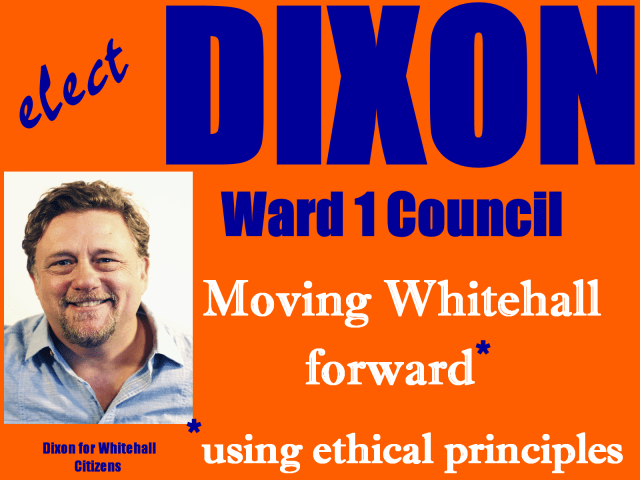
In the mayor’s messaging (and that of some of her picks running for council), we have seen the message ‘Moving Whitehall Forward’ (as if the rest of us want to move it backward!). While that is a statement anyone with reason could get behind, it naturally doesn’t tell you the whole story. (By ‘Naturally’ I mean the parts Mayor Maggard never discloses or mentions publicly but which one can find with investigation, like I have.) That rest of the story which has been documented here which includes underhanded behavior within the movement of this progressive statement.
I created this version of my yard sign you’ve seen across Ward 1 as a tongue-in-cheek jab at their feel-good messaging. Its one thing to move Whitehall forward but in what spirit and with what actions are you doing so? I maintain Mayor Maggard has, on occasion, abused the power of her office to ‘move Whitehall forward’ and so, it is not enough to simply trust that is the only thing she or others will do within that. As such, I will remind her and everyone else, that one must do so in an ethical fashion. After all, they are representing us, not just themselves.
http://web.mnstate.edu/gracyk/courses/phil%20115/Four_Basic_principles.htm
The ethical principles I speak of and which should inform every elected officials actions are these then:
Four fundamental ethical principles (a very simple introduction)
• The Principle of Respect for autonomy
Autonomy is Latin for “self-rule” We have an obligation to respect the autonomy of other persons, which is to respect the decisions made by other people concerning their own lives. This is also called the principle of human dignity. It gives us a negative duty not to interfere with the decisions of competent adults, and a positive duty to empower others for whom we’re responsible.
Corollary principles: honesty in our dealings with others & obligation to keep promises.
• The Principle of Beneficence
We have an obligation to bring about good in all our actions.
Corollary principle? We must take positive steps to prevent harm. However, adopting this corollary principle frequently places us in direct conflict with respecting the autonomy of other persons.
• The Principle of nonmaleficence
(It is not “non-malfeasance,” which is a technical legal term, & it is not “nonmalevolence,” which means that one did not intend to harm.)
We have an obligation not to harm others: “First, do no harm.”
Corollary principle: Where harm cannot be avoided, we are obligated to minimize the harm we do.
Corollary principle: Don’t increase the risk of harm to others.
Corollary principle: It is wrong to waste resources that could be used for good.
Combining beneficence and nonaleficence: Each action must produce more good than harm.
• The Principle of justice
We have an obligation to provide others with whatever they are owed or deserve. In public life, we have an obligation to treat all people equally, fairly, and impartially.
Corollary principle: Impose no unfair burdens.
Combining beneficence and justice: We are obligated to work for the benefit of those who are unfairly treated.
Finally, I find it ultimately sad having to even remind elected leaders of these most basic tenets of self-governing; the movements of ourselves which direct our behavior and actions in life and society.

 Whitehall Watchblog
You must be logged in to post a comment.