
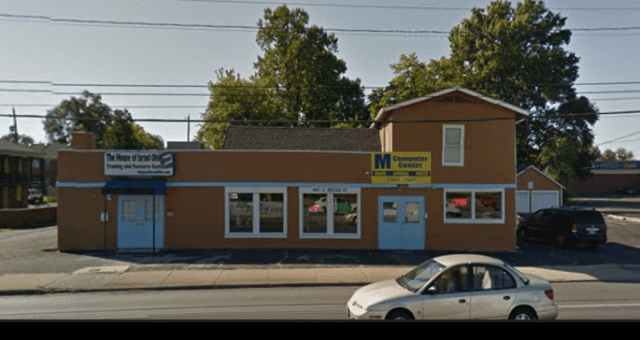
 A week or so ago, Mayor Maggard gave a ‘State of the Community’ speech alongside the Superintendent of WCS and the Whitehall Area Chamber of Commerce. Of the many items regarding development in the city that she highlighted, one in particular stuck out for me. Speaking of the acquisition and development of the former Fairport Apartment complex, of which we’ve all been apprised, she added that the additional properties surrounding the complex would also be acquired and the land would be made part of the development complex.
http://www.whitehall-oh.us/CivicAlerts.aspx?AID=157
These are the little shopping center where ‘Shrimp Hut’ is located, the three apartment buildings to the north of it, the old Sunoco at the corner and also in negotiation, the little old building east of Holiday Lanes that houses ‘M Computers’. It was this last one that struck me during her talk and, like ‘The Manor’s’ destruction in Woodcliffe, I couldn’t help but feel sad about this buildings ultimate demise too.
We all have various natural traits which make up our individual selves, those assets which we bring to the table that are part of our unique offering. One of mine, according to the renowned Myers-Briggs test, is that of ‘guardian’.
https://en.wikipedia.org/wiki/Guardian_temperament
I tend to protect and keep things in order. I am a natural guardian of not just buildings and things but also systems and orders, like the ethics and principals I’ve worked so hard to defend here in Whitehall. My blog here is filled with examples of my defense of these things. When they are in danger it, as the Wikipedia article points out, stresses me out. As such, you can only imagine how I felt when every single school building from Whitehall’s history was leveled, particularly given my having lived in NYC where school buildings still stood and were active which had been around when Lincoln was still alive. Something which is a part of the human history of a place, that which had withstood the tests of time. Gone in an instant in the name of ‘development’ or ‘progress’ with little fanfare or mourning. Unique places that had housed the community’s spirits, their gains and losses, their exuberance and happiness and everyday lives. How that can be torn out of a community’s self with no more than a shrug of the shoulders is beyond me. So it is too then with the ‘M Computers’ building.
http://apps.franklincountyauditor.com/ParcelSheet/090-000096-00
If you look closely, you can see its farmhouse origins. The original frame of the house is still noticeable above the façade’s roofline. It had a north/south westerly side attached to an east/west portion. It was built along the former Columbus-Granville Plank Road and was probably part of a farm (like others still standing further east past Reynoldsburg). The roads widening no doubt brought it closer to the house, as it is today. With houses of this variety, there was usually a porch, probably on the left side which they could watch carriages, and later automobiles, as they passed the house. According to the Franklin County Auditor’s website, there has been a store there as far back as 1920 (any records previous to 1920 were lost in a fire). It was owned by a Charles Spatz for the majority of the Great Depression and has stood for the entirety of the City of Whitehall’s history. It is perhaps the last farmhouse left of Whitehall’s past still standing on Broad Street. That in itself is enough to mourn its ultimate demise but there is more.
In the early to mid-mark of the 20th Century there had been a golf course on the north side of East Broad Street. To my recollection (from Ray Downing, who was born in 1920 in a house that stood where the Wendy’s on Broad Street is and who’d worked there in his youth) it was called the Town and Country Golf Club. As a result of this there was a bar at this location on Broad Street called the ‘Par-4 Lounge’. I believe the neon sign out front had a putter and golf ball on the sign, that which may have baffled those who weren’t aware of the defunct golf course the bar took its name from. The bar itself survived long after the golf course, into the late ‘70’s or early 80’s. At one point or another, both my parents bartended there. When my Mother had to work at General Diaper Service in the day and they couldn’t afford a babysitter, I and my two brothers would spend the day at the Par-4 Lounge, slugging back kiddy cocktails, playing pool under the smoke-hazed light suspended over the table and making selections on the mini-jukeboxes located at every booth; Patsy Cline and Ray Price’s music filling the room on grey Saturdays while my Father poured Old Milwaukee and Old Crow for old men at the L-shaped bar. Their music and that bar hold dear childhood memories for me, as does the great pizza made in their kitchen by the wonderful Mary (I don’t remember her last name). My Father used to take us in through the kitchen door and we’d say hello to Mary and it always smelled of pizza. I always felt like an ‘insider’ going in that way with my father. It was a very popular nightspot back in the day when Whitehall had many bars and night life. I remember my glamorous Mother coming home from a ‘night out’ at the Par-4 in her fur jacket and knee high boots smelling of an exciting mix of alcohol, cigarettes and perfume.
After the demise of the Par-4 Lounge, it had different businesses come through, most with little staying power next to the Par-4. Now there is ‘M Computers’ which has been holding its own now for several years.
My point in writing this blog entry is really not to take issue with the Mayor’s office and the Development Director taking a troubled area and doing what they can and must, in a just fashion, to turn it around for the sake of the community’s health and interest. Nor do I write this to excoriate developers for doing what comes naturally to them. Developers gotta develop. No. My point, which any fellow ‘guardian’ would appreciate, is that sometimes, particularly with cities hungry for change and economic development coupled with ‘developers who gotta develop’, the cost for that change and development is often at the expense of our shared built history, that which makes up the human aspect of a communities experience. No guardian or poet ever looked at a building made of brick and mortar and saw only that. They are the trustees of the dreams and sacrifices and human drama and existence of a community, that which filled those buildings with heart and soul, and when that brick and mortar is leveled back to point zero, they are the ones who most greatly mourn and recognize the community’s larger loss in that leveling. A loss which rarely receives the sensitive consideration due it by those city officials and developers in their singular pursuits. And so it is.
Mike Wallace, Distinguished Professor of History at John Jay College of Criminal Justice, CUNY said, regarding this topic;
“ Since the 1920’s it’s been ‘modern, modern, modern’, and modern means ‘dump the past’, ‘break with the past’, ‘think new’, ‘think art deco’, ‘think streamlined’, ‘think projectile’…tear down the old stuff, not just because, although it may be, a constraint on our ability to make profits but, because its old, the new is intrinsically superior to the old but, Jacobs (Jane Jacobs, renowned critic of bad city planning) says, wait a minute, part of the texture of life in a city is that people are not just connected to each other on the street by virtue of being neighbors but they’re connected in time. There’s some sense in the buildings around you that remain that give you a sense of being part of a continuum, that history isn’t dead, its not something which has been transcended, today is not the first day of the rest of your life. People are beings in time and they need to be surrounded, not entirely but…to some extent, by the legacy of the built environment of the past.”
I would add to Professor Wallace’s wisdom, this; that old farmhouse has been sitting there longer than anyone in Whitehall been alive today. It is older than us; it has survived longer than we’ve been alive. For that alone, outside of any historical importance it may have, it is worthy of a community’s note, certainly as it passes into the dustbin of history. To not give it its due in that is to disrespect and diminish that heart and soul our community’s forbearers imbued it with.
So…if it goes, I guess, it goes. My sadness at yet another building from our community’s past being torn down will remain with me, as it does with so many others now gone. But, my concern ultimately lies more with the community itself, that which allows piece by piece of its shared past to be torn down for ‘progress’ and profit (and grants). Where the landscape has nothing left from its past to inform the identity of the community’s present and all that’s left is a dull, standardized corporate-identity to supplant it. Unless the citizens themselves, with the Whitehall Historical Society leading the charge, stand up and demand their elected officials get on board preservation (and re-use) over development of the remnants of our shared history, it will become ever more elusive for our city to hold onto the identity our shared past has the ability to enrich us with.
In memoriam:
The Manor at Woodcliffe
Whitehall-Yearling High School
Rosemore Junior High School
Etna Road Elementary
Robinwood Elementary
Beechwood Elementary
East Broad St. Elementary
East Main Elementary
Town and Country Cinema
Abram Doney House
George Yearling House
Ye Olde Whitehall Tavern
White gingerbread house on Yearling close to Etna
(gone for 6 parking space
Etc…

 Whitehall Watchblog
You must be logged in to post a comment.